Blog
2026 How to Choose a Chocopie Cake Production Line?
Choosing a Chocopie Cake Production Line in 2026 requires more than comparing hourly output. The decision should connect product quality, labor conditions, energy use, food safety, and long-term service support. A beautiful machine can still become an expensive bottleneck.
Industry data shows why this choice matters. Grand View Research’s 2024 bakery products report identifies continuing growth in packaged bakery demand, driven by convenience and longer shelf-life expectations. PMMI’s 2024 report on automation in food and beverage packaging also highlights labor shortages and the growing use of integrated inspection and packing systems. These findings support a practical direction: the Chocopie Cake Production Line should combine stable forming, accurate depositing, controlled baking, gentle cooling, chocolate enrobing, and reliable wrapping.
Numbers need context.
A line rated for 20,000 pieces per hour may not sustain that speed with sticky fillings, frequent flavor changes, or uneven cooling. In real factories, operators often lose time during cleaning, film replacement, mold adjustment, and quality checks. This is where supplier experience becomes valuable. Ask for production records, test-batch results, sanitation procedures, spare-parts availability, and documented energy performance. HACCP-based controls, traceability, allergen management, and food-contact material compliance should be verified before purchase.
There is no perfect configuration. A smaller modular line may offer better flexibility than a massive system. However, underestimating future demand can create costly expansion problems. The right evaluation balances present capacity with realistic growth, measurable product consistency, and the daily experience of the people running the equipment.
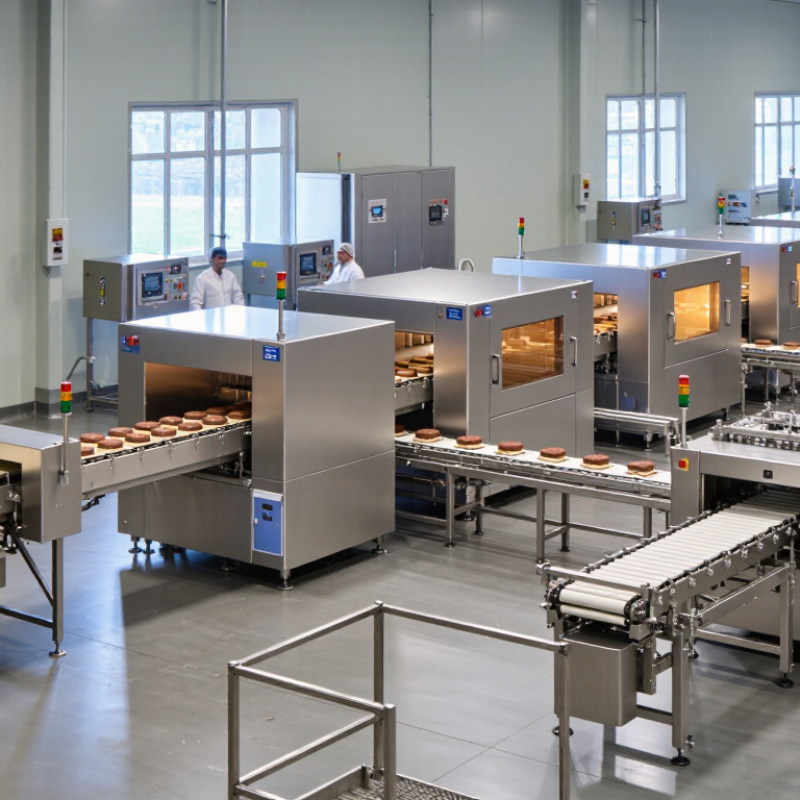
Define Product Specifications and Production Requirements
2026 How to Choose a Chocopie Cake Production Line?
Define Product Specifications and Production Requirements
A suitable chocopie line begins with a clear product brief, not a machine catalog. Define cake diameter, height, weight, filling volume, coating thickness, and daily output. A 35-gram cake needs different dosing accuracy than a 70-gram format. Record target moisture, texture, shelf life, and acceptable breakage rates. Small details decide line capacity.
The International Cocoa Organization estimated 2023/24 global cocoa production at about 4.46 million tonnes. This scale does not guarantee stable ingredient performance. Cocoa powder, fat, syrup, and flour can vary by supplier and season. Test each recipe under real production conditions. Measure batter viscosity, baking loss, filling temperature, and coating setting time. Do not trust laboratory results alone.
PMMI reports that food and beverage manufacturers continue investing in automation, digital monitoring, and labor-saving equipment. Your line should therefore support recipe control, batch traceability, and production data collection. Specify whether the target is 1,000, 3,000, or 6,000 pieces per hour. Include sanitation time and changeover time. They are often ignored.
Leave room for mistakes. A line designed only for today’s recipe may become restrictive within a year. Check cleaning access, spare-part availability, operator safety, and expansion options. Confirm performance with factory acceptance testing. Ask for evidence from comparable cake products, not general promises. The cheapest line can become expensive after frequent adjustments.
Calculate Capacity, Layout, and Automation Needs
Choosing a Chocopie Cake Production Line in 2026
Capacity, Layout, and Automation Needs
A practical choice begins with demand, not machine speed. Estimate daily sales, seasonal peaks, product rejects, and cleaning time. For example, 120 cakes per minute may produce 57,600 cakes in an eight-hour shift, before downtime. A safer design uses realistic efficiency, often 75–85 percent during early operation. Leave room for growth. However, excessive capacity can leave expensive equipment idle.
Map the line on paper before requesting quotations. Place mixing, baking, cooling, filling, coating, and packing in a logical flow. Keep raw-material movement separate from finished-product traffic. Measure doors, ceiling height, drainage, electrical supply, and maintenance access. A narrow service aisle becomes a daily problem. I have seen efficient layouts fail when operators needed to remove a cooling belt. That mistake delayed cleaning and repairs.
Tips: Compare current demand, peak demand, and a five-year target. Choose automation by task risk. Automatic dosing and temperature control improve consistency, while manual loading may suit smaller batches. Ask for actual output using your recipe, product size, and shift pattern. Test changeover time, noise, cleaning access, and operator training. Do not trust impressive capacity figures without trial records. Reject handling matters too. Without a clear route, good products and defects can mix.
2026 How to Choose a Chocopie Cake Production Line? - Calculate Capacity, Layout, and Automation Needs
| Planning Dimension | Compact Line | Mid-Scale Line | High-Capacity Line |
|---|---|---|---|
| Typical nominal output | About 60 pieces/minute | About 120 pieces/minute | About 240 pieces/minute |
| Estimated saleable output per year | About 14.7 million pieces | About 29.4 million pieces | About 58.8 million pieces |
| Annual output calculation basis | Illustrative estimate: nominal rate × 60 minutes × 16 scheduled hours/day × 300 days/year × 85% overall equipment effectiveness (OEE). Actual output depends on product size, changeovers, downtime, quality losses, and operating schedule. | ||
| Main process stages | Batter mixing and depositing; baking; shell cooling; marshmallow depositing; shell pairing; chocolate enrobing; final cooling; inspection; primary and secondary packaging. | ||
| Indicative line length | Approximately 35–50 m | Approximately 50–75 m | Approximately 70–100 m |
| Indicative production area | Approximately 700–1,100 m² | Approximately 1,100–1,800 m² | Approximately 1,800–2,800 m² |
| Layout priorities | Keep the oven, cooling conveyor, enrober, and packer in a compact one-way flow. Reserve access for cleaning and maintenance. | Provide space for ingredient staging, packaging-material supply, parallel work zones, and access around long cooling conveyors. | Plan for multiple packaging lanes or parallel modules, larger material-handling routes, maintenance access, and room for future expansion. |
| Typical automation focus | Automated depositing and baking; controlled enrobing and cooling; assisted case packing may be appropriate. | Automatic shell pairing, synchronized transfers, in-line inspection, flow wrapping, and case packing are commonly considered. | Integrated line controls, automatic product handling, inspection and rejection, multi-lane packaging, and automated case handling may support the target rate. |
| Indicative direct operators per shift | About 8–12 | About 10–16 | About 14–22 |
| Staffing considerations | Indicative production staffing only. Include separate provision for quality checks, sanitation, maintenance, material handling, supervision, and relief coverage. Actual staffing depends on packaging format and the factory’s operating procedures. | ||
| Key capacity checks before purchase | Confirm that the oven, cooling conveyors, marshmallow depositor, enrober, and packaging equipment can all sustain the required rate. Check output using the intended cake dimensions, coating weight, pack format, and changeover frequency. | ||
| Utilities and factory checks | Request equipment-specific electrical, compressed-air, ventilation, cooling, and heat-removal requirements. Verify floor loading, ceiling height, drainage, food-safe construction, cleaning access, and local food-safety requirements with the equipment supplier and facility engineer. | ||
| Planning note | Footprint, staffing, and line-rate figures are preliminary planning ranges, not guaranteed specifications. Final selection should be based on a product trial and a detailed layout using the chosen recipe, product dimensions, packaging, and site conditions. | ||
Compare Forming, Baking, Filling, and Coating Equipment
2026 How to Choose a Chocopie Cake Production Line?
Choosing a chocopie cake line in 2026 requires more than comparing hourly output. The forming unit must deposit equal cake portions without tearing soft batter. Servo control helps adjust weight, diameter, and spacing during recipe changes. During production trials, inspect the nozzle area after continuous running. Small batter buildup can create uneven edges and costly rejects. A clean changeover matters.
Baking equipment determines structure, moisture, and the cake’s ability to hold filling. A tunnel oven with stable temperature zones supports even color and flexible texture. Ask for recorded temperature maps, not only rated capacity. Check belt speed, airflow, heat recovery, and cleaning access. Overbaking may seem safer, but it creates dry layers that crack during sandwiching. That tradeoff is easy to miss.
The filling system should control volume precisely and prevent cream leakage at the edges. Piston or pump selection depends on viscosity, particle size, and target portion. Coating equipment needs stable curtain flow, cooling control, and accurate product alignment. Measure chocolate thickness across the cake, rather than judging appearance alone. Leave room for operator access and future capacity. Test short stoppages, too. A line that performs well for twenty minutes may struggle after repeated starts. Specifications deserve careful questioning.
Check Food Safety, Quality Control, and Maintenance Features
Choosing a chocopie cake production line in 2026 requires more than checking output speed. Food safety begins with hygienic design, including smooth stainless surfaces, sealed bearings, and easy drainage. The line should separate raw batter, baked cakes, cream, and finished products. This reduces cross-contact risks during busy changeovers. Verify materials and procedures against local food-safety requirements. Ask to inspect cleaning access, not only glossy machine panels. That detail matters.
Quality control should follow the cake through every stage. Temperature sensors can identify uneven baking before texture changes reach packing. Servo-controlled depositors help maintain filling weight, while vision systems can detect cracked shells or missing coatings. Metal detection, batch records, and clear rejection systems support traceability. I have seen trial runs look perfect, then drift after several hours. Request extended testing with real ingredients, not water alone. They may disappoint.
Maintenance features often decide whether a line remains profitable. Choose guarded access points, readable manuals, spare-part lists, and reachable lubrication points. Remote diagnostics can help, but they should not replace trained inspections. Record belt wear, nozzle performance, oven temperatures, and cleaning time. A practical factory also needs sanitation training and documented preventive maintenance. Do not assume automation removes human error. That assumption can fail.
Evaluate Suppliers, Installation Support, and Total Cost of Ownership
How to Choose a Chocopie Cake Production Line in 2026
Supplier evaluation should begin with evidence, not attractive samples. Request factory acceptance test records, hourly output data, defect rates, and references from similar cake lines. A reliable supplier explains how batter viscosity, filling temperature, and coating thickness affect performance. Ask for a written installation plan. It should identify electrical work, compressed-air needs, sanitation zones, and operator training. Details matter.
Installation support directly affects production risk. The U.S. Bureau of Labor Statistics projects 15% employment growth for industrial machinery mechanics from 2022 to 2032. Skilled support may become harder to secure. Confirm whether engineers provide on-site commissioning, remote troubleshooting, spare-parts training, and response-time commitments. A video call is helpful. It is not the same as standing beside a stopped depositor.
Total cost of ownership includes more than the purchase price. The U.S. Department of Energy reports that compressed air can consume 10–15% of industrial electricity in some plants. Compare air consumption, heating demand, cleaning time, labor hours, tooling life, and planned maintenance. Calculate cost per saleable cake, not cost per machine. PMMI research repeatedly highlights workforce pressure and the value of automation support in packaging operations. Still, supplier estimates can be optimistic. Test their assumptions with your own utility rates, shift pattern, and rejected-product records. A spreadsheet may reveal an uncomfortable answer. The cheapest line can become the most expensive after installation.