Blog
2026 Top PCR Cosmetic Tube Types for Global Buyers
The 2026 packaging conversation is moving from recycled claims to measurable performance. A PCR Cosmetic Tube must protect formulas, satisfy filling lines, and communicate credible environmental value.
The OECD’s Global Plastics Outlook reports that only 9% of plastic waste was recycled globally in 2019. That figure exposes the pressure on brands to improve material choices. Smithers’ Future of Sustainable Packaging to 2028 also identifies recycled content, lightweighting, and recyclability as major packaging priorities. These findings support stronger demand for post-consumer recycled polyethylene tubes, mono-material PE tubes, and PCR-compatible laminate structures.
Performance still matters.
PCR polyethylene can show color variation, odor concerns, and different sealing behavior. These details become visible under bright retail lighting. They may also affect decoration, shoulder appearance, and filling-line stability. Cosmetic buyers should request resin documentation, PCR percentage, migration testing, compatibility data, and batch-level quality records. The Ellen MacArthur Foundation’s Global Commitment framework emphasizes transparent packaging data and circular design principles, giving procurement teams a useful reference for supplier evaluation.
This article reviews the top Pcr Cosmetic Tube types expected to attract global buyers in 2026. It compares material structures, barrier protection, appearance, recyclability, and practical production risks. Market reports provide direction, but they cannot replace factory trials. Data is imperfect. A tube that performs well for a hand cream may fail with a volatile serum or oil-rich mask. Buyers should therefore judge each option against formula sensitivity, decoration requirements, local recycling systems, and total supply-chain impact. That approach is more reliable than selecting PCR content by percentage alone.
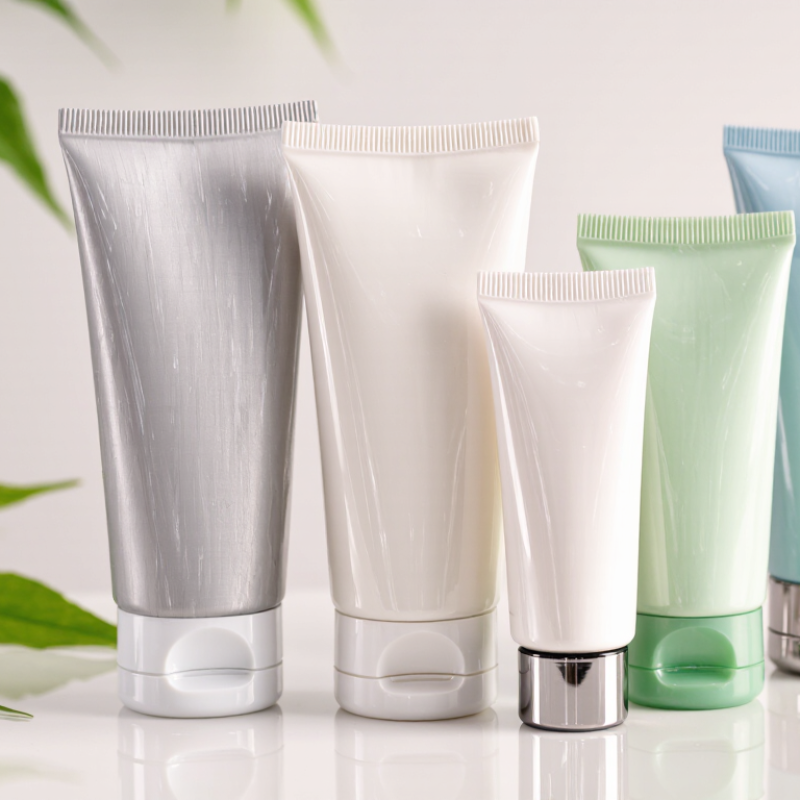
PCR Cosmetic Tubes: Definition, Materials, and Sustainability Benefits
2026 Top PCR Cosmetic Tube Types for Global Buyers
PCR Cosmetic Tubes: Definition, Materials, and Sustainability Benefits
PCR cosmetic tubes use plastic recovered from household waste after consumer use. The material is cleaned, sorted, processed, and remade into packaging components. It differs from post-industrial recycled plastic, which comes from factory production waste. This distinction matters when buyers verify sustainability claims.
Most PCR tubes use recycled HDPE, PP, or mixed polyethylene structures. HDPE offers stiffness and good chemical resistance. PP supports closures, caps, and higher-temperature processing. Some tubes combine a PCR outer layer with a virgin inner layer. This design protects formulas while increasing recycled content. Tube shoulders, caps, seals, and decorative coatings also require separate compatibility checks.
Sustainability benefits include reduced demand for new fossil-based resin and stronger demand for collection systems. A tube with 30% PCR may reduce virgin plastic use, but the result depends on factory energy, transport, and recycling access. Numbers need evidence. Buyers should request recycled-content declarations, batch records, safety tests, and supply-chain traceability. Mechanical testing should examine squeeze force, drop resistance, seal integrity, and leakage after storage. Appearance can vary slightly, especially with darker PCR resin. That is normal, yet it may challenge strict color expectations. In my experience, early filling-line trials reveal problems that laboratory samples sometimes miss. PCR is useful, but it is not automatically sustainable.
Leading PCR Cosmetic Tube Types for Different Product Formats
PCR cosmetic tubes are expanding across several product formats, but material selection still needs discipline. The OECD’s Global Plastics Outlook reports that only 9% of plastic waste was recycled globally in 2019. This gap makes verified post-consumer recycled content important for international buyers.
For facial cleansers and body lotions, PCR HDPE or PP squeeze tubes offer practical durability and familiar dispensing. They suit thicker formulas and standard flip-top closures. PCR laminate tubes provide stronger barrier protection for creams, scrubs, and toothpaste-like products. Their layered structure can improve shape retention, but recycling compatibility requires careful supplier verification.
For lightweight serums and sensitive formulations, PCR airless tubes can reduce backflow and limit repeated air exposure. They also support controlled dosing, especially with low-viscosity products. However, PCR resin may vary in color, odor, and melt flow. That difference can affect decoration, sealing, and pump performance. Testing matters more than attractive sustainability claims.
UNEP’s 2023 Turning off the Tap report estimates that global plastic pollution could fall by 80% by 2040 through reuse, recycling, and reduced material use. PCR tubes support this direction, but they are not a complete solution. In my packaging evaluations, the weak point is often inconsistent PCR traceability. Buyers should request recycled-content certificates, migration testing, compression tests, and closure compatibility data. A tube can look recycled and still perform poorly.
2026 Top PCR Cosmetic Tube Types for Global Buyers
Leading PCR cosmetic tube types for different product formats
The suitability index uses a 1–5 technical rating based on common packaging requirements: flexibility, squeeze performance, barrier protection, product compatibility, and dispensing control. Mono-material PE tubes generally offer the broadest PCR integration potential, while barrier and high-protection formats are more specialized.
Key Performance Features Global Buyers Should Compare
PCR Cosmetic Tube Types for Global Buyers: Key Performance Features Global Buyers Should Compare
Post-consumer recycled (PCR) tubes are not automatically equal. HDPE tubes usually offer strong stiffness and reliable shape retention, while PP tubes can provide better heat resistance and hinge performance. Laminated structures may improve oxygen and moisture protection, but recycling compatibility requires closer review. The OECD Global Plastics Outlook reports that only 9% of global plastic waste was recycled in 2019. That figure makes verified PCR content more important than attractive sustainability claims.
Global buyers should compare PCR percentage, resin source, wall thickness, squeeze recovery, and closure fit. Check whether the tube remains stable after repeated compression. Test leakage, odor, color variation, and print adhesion under humid transport conditions. Cosmetic packaging experts should also request migration testing and batch-level certificates. ISO 14021 supports transparent recycled-content claims, while ISO 18604 provides guidance for recyclable plastic packaging. These standards help, but they do not replace practical factory testing.
Barrier performance can change when PCR resin contains mixed polymers or inconsistent additives. Darker colors may hide variation, yet they can limit visual quality for pale formulas. Small defects matter. A cap that loosens by one millimeter can create costly leakage. The Ellen MacArthur Foundation’s Global Commitment reporting continues to show that recycled-content progress remains uneven across packaging markets. Buyers should therefore compare three production batches, not one sample. The honest question is simple: does the tube protect the formula after months of handling, or only look responsible on delivery?
How to Select PCR Tubes by Product, Market, and Packaging Needs
PCR cosmetic tubes should match the formula, not only the sustainability claim. For face cream, body lotion, and cleanser, PCR polyethylene tubes offer familiar squeeze performance. However, higher PCR content can affect color consistency, odor, and seal strength. For oxygen-sensitive products, use a multilayer structure with a barrier layer. For lighter formulas, a mono-material tube may simplify future recycling. Tube shoulder shape, cap weight, and opening size also affect consumer use.
Market requirements vary sharply. The OECD’s Global Plastics Outlook reports that only 9% of global plastic waste was recycled in 2019. UNEP’s 2023 report says plastic pollution could fall by 80% by 2040 through better design and reuse systems. These findings support measurable PCR content, but they do not replace local recyclability checks. Buyers should confirm resin compatibility, recycled-content documentation, migration testing, and production-line performance. Claims need evidence.
Request three pilot samples. Test them with the real formula, at different temperatures, and after transport vibration. Compare PCR percentages, barrier performance, decoration adhesion, and cap fit. Ask whether the tube remains recyclable in the target market. A tube can look excellent in a sample room, yet fail during filling. That risk is real.
Global Compliance, Sourcing, and Quality Considerations for 2026
2026 Top PCR Cosmetic Tube Types for Global Buyers
Global buyers are prioritizing PCR cosmetic tubes, but material selection requires more than recycled-content claims. PCR polyethylene tubes suit lotions, gels, and many everyday formulas. PCR polypropylene tubes offer stronger heat resistance and may support thicker products. PCR laminate tubes can improve barrier performance, although their layered structures may complicate recycling.
Performance comes first. Always request the PCR percentage, resin origin, batch traceability, and safety documentation. A recycled-content certificate is not enough. Suppliers should provide migration data, compatibility testing, odor checks, and closure torque results. Test filled tubes under heat, cold, pressure, and transport vibration. A small leak can damage an entire shipment.
Global compliance is not uniform. Buyers should review packaging rules in each destination market, including recycled-content claims, labeling, recycling marks, and chemical restrictions. Ask whether pigments, inks, adhesives, and caps follow the same requirements as the tube body. Supplier audits should examine production hygiene, change control, and corrective-action records. Experience shows that attractive samples can hide weak sealing or inconsistent wall thickness. We still need to challenge our assumptions. A tube that passes one formula test may fail after six months of storage. Keep retained samples, define acceptance limits, and approve production only after documented quality checks.
2026 Top PCR Cosmetic Tube Types for Global Buyers - Global Compliance, Sourcing, and Quality Considerations for 2026
| PCR Tube Type | Typical Structure | Common PCR Content Target | Best-Fit Cosmetic Applications | Key Quality Considerations | Global Compliance and Documentation | Sourcing Advantages | Main Limitations or Risks |
|---|---|---|---|---|---|---|---|
| PCR-HDPE Squeeze Tube | Single-layer or multilayer high-density polyethylene body with PCR-HDPE blended into the tube wall. | Approximately 20%–70%, depending on appearance, odor, mechanical performance, and supplier process. | Shampoo, conditioner, body wash, hand cream, lotion, cleanser, and non-sensitive personal-care products. | Check wall uniformity, squeeze recovery, stress cracking, odor transfer, color consistency, cap fit, and leakage after transport testing. | Request recycled-content evidence, safety and restricted-substance declarations, batch traceability, migration assessment where relevant, and packaging specifications. Requirements depend on destination market and product use. | Broad availability, relatively simple processing, competitive cost, and good compatibility with standard flip-top or screw caps. | Higher PCR levels may increase grayness, speckling, odor, viscosity variation, or surface defects. PCR feedstock quality can vary by batch. |
| PCR-LDPE Squeeze Tube | Flexible low-density polyethylene body containing PCR-LDPE, normally paired with a polyethylene-based shoulder and cap. | Approximately 15%–50% for cosmetic-grade flexible packaging; validated levels vary by formulation and finish. | Face wash, moisturizer, sunscreen, hair styling products, body lotion, and travel-size products. | Evaluate softness, dimensional recovery, puncture resistance, seal integrity, print adhesion, and compatibility with oils, alcohols, acids, and essential oils. | Confirm material identification, recycled-content percentage, colorant compliance, product-contact safety assessment when applicable, and regional labeling obligations. | Good tactile feel, easy dispensing, and suitability for a wide range of conventional tube filling lines. | PCR may reduce clarity and affect squeeze behavior. Very high recycled content can complicate decoration and dimensional control. |
| PCR-PE Mono-Material Tube | Primarily polyethylene tube, shoulder, and cap designed to support mechanical recycling where local systems accept the format. | Approximately 20%–50% PCR in the body; the overall package percentage must be calculated by component weight. | Mass-market skincare, bath products, haircare, and products seeking a simplified material declaration. | Confirm polymer compatibility across all components, cap-to-body separation behavior, seal performance, stiffness, decoration coverage, and recyclability test results. | Use accurate material claims supported by component-weight calculations. Recyclability is market-specific and should not be claimed solely because the package is made from one polymer family. | Simpler material communication, potential sorting advantages, and reduced dependence on mixed-material laminates. | Barrier performance may be lower than multilayer or aluminum-barrier formats. Local collection and reprocessing infrastructure may be limited. |
| PCR Co-Extruded Barrier Tube | Multiple layers, commonly including polyethylene-based outer and inner layers with a barrier layer or tie layers; PCR is usually concentrated in selected layers. | Approximately 15%–40% overall, subject to barrier design and required product protection. | Vitamin creams, active skincare, oxygen-sensitive formulations, high-oil products, and products requiring improved aroma retention. | Test oxygen transmission, moisture transmission, light protection, flavor or fragrance retention, layer adhesion, delamination, and long-term formula compatibility. | Request a layer diagram, material declarations, recycled-content calculation, barrier test reports, and evidence that the structure meets destination-market packaging rules. | Provides stronger product protection than a basic mono-layer tube while allowing a controlled PCR contribution. | Mixed layers can reduce recycling compatibility. Higher tooling complexity may increase minimum order quantity, lead time, and qualification cost. |
| PCR Plastic-Aluminum Laminate Tube | Plastic layers laminated around a thin aluminum barrier layer, with PCR generally incorporated into the plastic layer where technically feasible. | Approximately 10%–30% of total package weight; verify the calculation because aluminum and other layers affect the total percentage. | Highly sensitive creams, ointments, pigment-rich products, and formulas requiring strong oxygen, moisture, or light protection. | Inspect pinholes, laminate bond strength, shoulder integrity, seal quality, flex-crack resistance, and barrier retention after filling and aging. | Provide full material composition and accurate environmental claims. Do not describe the package as mono-material or widely recyclable without market-specific evidence. | Excellent barrier performance, strong protection for sensitive formulas, and established filling technology. | Difficult material separation, limited recycling routes in many regions, and potentially higher environmental-claim scrutiny. |
| PCR Cosmetic Tube with PCR Cap | PCR tube body combined with a cap containing recycled polypropylene or polyethylene, depending on the closure design. | Body commonly 20%–50%; cap commonly 20%–80%. Report body, cap, and total-package values separately. | Retail skincare, haircare, bath products, and packaging programs targeting a higher recycled-content percentage. | Check hinge fatigue, opening force, torque, thread fit, closure leakage, tamper evidence, and color matching between body and cap. | Maintain component-level bills of materials, recycled-content certificates, testing records, and declarations for restricted substances and packaging labeling. | Can raise total recycled content without placing the full PCR burden on the flexible tube body. | Different polymers between body and cap may complicate recycling instructions and color coordination. |
| PCR Tube with Post-Consumer Recycled Content and Printed Decoration | PCR plastic tube using offset, flexographic, digital, or screen printing, with optional protective varnish. | Approximately 20%–50% PCR, depending on required surface appearance and decoration coverage. | Premium-looking skincare, color cosmetics, salon products, and promotional or seasonal packaging. | Test ink adhesion, rub resistance, barcode readability, color variation, curing, chemical resistance, and print performance over the complete PCR color range. | Review ink and coating declarations, packaging claim substantiation, artwork requirements, recyclability impact, and market-specific labeling rules. | Allows controlled visual branding while using PCR material that may have natural color variation. | Opaque or darker PCR substrates can require more ink coverage. Decoration may affect recycling preferences and cost. |
Buyer Verification Notes for 2026
PCR percentages shown are indicative commercial ranges rather than universal specifications. The final percentage depends on component weight, resin availability, processing conditions, color requirements, and supplier validation. Before approval, request a complete bill of materials, recycled-content calculation, traceability documents, safety and restricted-substance declarations, compatibility data, production samples, and transport and aging test results. Recycling claims must be assessed against the collection, sorting, and reprocessing infrastructure of the intended sales market.