Blog
10 Best CNC Panel Bender Manufacturers for Global Buyers
Choosing among the 10 Best Cnc Panel Bender Manufacturers for Global Buyers takes more than comparing advertised speed. A Cnc Panel Bender can form return flanges, short hems, and complex profiles with minimal manual handling. Yet results depend on part geometry, material thickness, tooling, and operator workflow. A machine that suits a high-volume appliance line may not fit a job shop’s changing orders.
The International Federation of Robotics reported 4,281,585 industrial robots operating in factories worldwide in 2023, in its World Robotics 2024 report. That figure reflects broader factory automation, not panel bender sales. Still, it shows why buyers increasingly assess machines as part of connected production. For a panel bender, check usable panel dimensions, automatic tool changes, programming support, service coverage, and integration options. Ask for a live demonstration using your own part drawings.
Quality expert W. Edwards Deming offered a useful manufacturing principle: “It is not enough to do your best; you must know what to do, and then do your best.” Applied here, that means defining the work before ranking suppliers. Published specifications can be hard to compare. Some details only become clear on the shop floor. A sharp return flange, a delicate coated surface, or a frequent changeover can expose gaps in a seemingly impressive specification. This guide compares ten manufacturers through practical buyer criteria, while recognizing that no single machine fits every factory. Review the evidence, test representative parts, and verify local support before deciding.
CNC Panel Benders: Operating Principles, Axes, and Sheet-Metal Applications
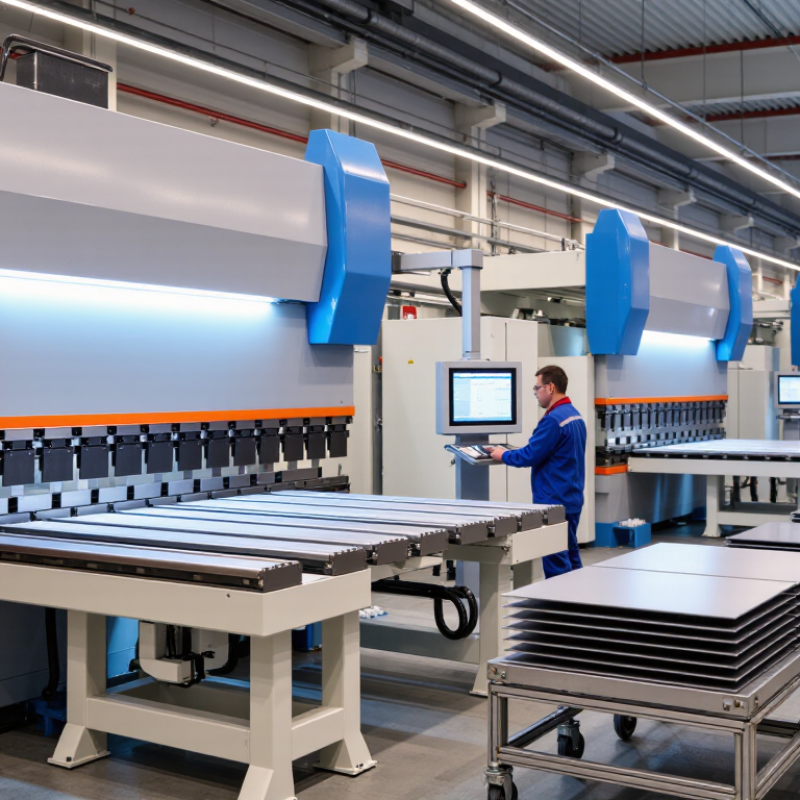
A CNC panel bender forms sheet metal through controlled clamping and bending. The operator loads a flat blank, and a clamp holds it against the machine table. Bending blades then move the sheet edge to the programmed angle. Depending on the machine, axes may position the back gauge, move the blades, rotate tooling, or handle the part. Their coordinated motion helps produce repeatable bends, but axis names and layouts vary by design.
Panel benders suit enclosures, cabinet doors, appliance panels, and other parts with multiple flanges. A programmed sequence can reduce manual repositioning and help maintain consistent dimensions across a batch. Still, real sheets are not perfectly uniform. Material thickness, grain direction, and springback can shift the finished angle. A careful operator checks the first piece with a measuring tool and adjusts the program when needed. Small details matter.
Selection Metrics: Bending Length, Sheet Thickness, Cycle Time, and Repeatability
CNC panel bender selection starts with the parts, not brochure claims. Measure the longest finished flange and account for tool clearance, handling space, and likely product changes. Bending length should cover the largest routine job, but extra capacity can raise purchase and operating costs. Check the sheet-thickness rating for each material type. Mild steel, stainless steel, and aluminum do not bend alike. A machine rated for a certain thickness in one alloy may struggle with another.
Cycle time needs a practical test. Ask suppliers to run a representative part, including loading, repositioning, bending, and unloading, rather than quoting one bend speed. Watch the operator’s workflow. Small delays add up. Repeatability matters just as much: run several parts and compare flange angles and dimensions. Check how calibration, tool wear, and sheet variation affect results. A tight tolerance on one clean sample is not enough. It is easy to overlook awkward shapes or mixed batches during a standard demonstration. Record the material grade, thickness, test conditions, and measurement method. If results vary, ask what setup changes are needed and how often. That answer may be less polished, but it is useful.
| 10 Best CNC Panel Bender Manufacturers for Global Buyers — Selection Metrics: Bending Length, Sheet Thickness, Cycle Time, and Repeatability | ||||||
|---|---|---|---|---|---|---|
| Shortlist Slot | Machine Profile | Usable Bending Length | Typical Sheet Thickness | Cycle-Time Benchmark | Repeatability Target | Buyer Verification Point |
| 1 | Compact-format panel bender | Up to approximately 1,000 mm | Thin sheet, commonly around 0.5–1.5 mm steel | Request cycle time for the buyer’s part and bend sequence | Confirm the supplier’s stated positioning and angle tolerances | Check minimum part size, tooling access, and loading method. |
| 2 | Small-batch flexible cell | Approximately 1,000–1,500 mm | Material- and tooling-dependent; verify by grade | Compare complete part-cycle time, including handling | Run repeated parts and inspect angle and flange variation | Ask how quickly the machine changes between part programs. |
| 3 | General-purpose production machine | Approximately 1,500–2,000 mm | Often suited to thin and medium-gauge sheet; confirm limits | Request cycle-time data for representative production parts | Review test-part results over a sustained run | Confirm rated capacity for the intended material and bend geometry. |
| 4 | Long-format cabinet and enclosure cell | Approximately 2,000–2,500 mm | Thickness capacity varies with material, length, and tooling | Measure the full cycle, including repositioning and unloading | Verify consistency across long flanges and repeated setups | Check floor-space, sheet-support, and operator-access requirements. |
| 5 | High-mix automated cell | Configuration-dependent; commonly selected by part envelope | Confirm separate limits for steel, stainless steel, and aluminium | Compare changeover time as well as bending time | Request repeatability data from a multi-part production trial | Assess programming, automatic tooling, and job-management workflow. |
| 6 | High-volume production line | Selected to match the largest recurring part | Use the exact production material and thickness for validation | Request measured output for the specified part mix | Check first-off and in-process inspection results | Include loading, unloading, downtime, and maintenance in throughput estimates. |
| 7 | Robot-loaded panel-bending system | Determined by the machine and automation layout | Verify handling limits as well as bending capacity | Evaluate end-to-end cell time, not standalone machine time | Check repeatability across both robot handling and bending operations | Confirm guarding, interfaces, and recovery procedures after a stoppage. |
| 8 | Large-panel specialist configuration | Specify the required maximum part length in the RFQ | Obtain a documented capacity chart for the requested length | Test the longest and most complex representative parts | Inspect dimensional results at multiple points along the panel | Ask for a witnessed acceptance test using the buyer’s drawings. |
| 9 | Precision-focused configuration | Choose length based on tolerance-critical parts | Validate each material and thickness combination separately | Record cycle time only after the part meets drawing tolerances | Define an agreed measurement method and tolerance before testing | Review calibration, compensation, and quality-control documentation. |
| 10 | Application-specific engineered cell | Defined by part envelope and production requirements | Set capacity from the actual material specification and geometry | Establish a baseline through a production-representative trial | Agree on sampling, measurement equipment, and acceptance criteria | Compare service coverage, spare-parts availability, and training plans. |
| Data note: The entries above are anonymous buyer-evaluation profiles, not verified specifications for ten individual manufacturers. Panel-bender capacity and cycle time depend on machine configuration, material grade, part geometry, tooling, and automation. Request current technical data and validate performance with representative parts before purchasing. | ||||||
10 CNC Panel Bender Manufacturers: Models, Markets, and Technical Strengths
CNC panel bender manufacturers serve different production needs, even when their machines look similar in a catalog. Compact models suit job shops making short runs of electrical enclosures or appliance panels. Larger systems target furniture, cabinet, and commercial equipment lines, where repeatable bends matter across long shifts. Model names vary, so compare working length, maximum sheet thickness, tooling range, and changeover time instead.
Technical strengths often appear in the details. A machine with automatic tool handling can reduce setup work for mixed orders. Servo-controlled axes help position narrow flanges accurately, while a stable frame limits movement during demanding bends. Some models support robotic loading for higher-volume factories; others favor flexible manual loading and quick operator access. Watch the material assumptions. A published capacity may depend on mild steel, a specific bend length, and ideal conditions.
Markets shape support as much as machine design. Buyers in growing manufacturing regions may value straightforward controls, accessible spare parts, and remote diagnostics. Established factories often prioritize integration with CAD/CAM systems, production monitoring, and service response times. Ask manufacturers for sample parts using your actual material and geometry. Small flanges can reveal problems.
A polished demonstration is useful, but not decisive. Request cycle-time data for a realistic job mix, then confirm what is included in the quoted configuration. Tooling, software, installation, and operator training can change the real cost. I would still question any comparison based only on maximum speed; that figure rarely reflects a full shift.
Factory Verification: ISO 9001:2015, ISO 12100:2010, and CE Compliance
For global buyers comparing CNC panel bender manufacturers, factory verification should go beyond a certificate shown on a sales call. ISO 9001:2015 provides a framework for quality management, but it does not certify a machine’s performance. The ISO Survey of Certifications to Management System Standards 2022 reported more than 1.2 million valid ISO 9001 certificates worldwide. That scale makes the certificate useful context, not proof that a particular factory controls every process well. Ask to see inspection records for a finished machine, calibration status for measuring tools, and traceability for critical components. Check a real production file, not just a polished presentation.
Safety needs equally practical evidence. ISO 12100:2010 sets out principles for machinery risk assessment and risk reduction. During a factory visit, review how hazards around the bending area are identified, and inspect guarding, access points, and emergency stops. CE marking is not a quality award; it signals the manufacturer’s declaration that applicable EU requirements are met. Request the EU Declaration of Conformity and confirm it covers the exact machine configuration being purchased. Details matter. A changed control system or optional safety device may affect the documentation. Certificates can be current while shop-floor habits remain inconsistent, so observe a machine running and ask operators how they handle faults. That part is sometimes awkward, but useful.
Global Purchasing: EU Machinery Regulation 2023/1230 Applies from 20 January 2027
For global buyers, 20 January 2027 is a key compliance date. Regulation (EU) 2023/1230 will apply from that day, replacing the Machinery Directive for machinery placed on the EU market. The regulation updates requirements for safety-related control systems and digital elements. It does not mean every panel bender automatically belongs to a high-risk category; classification depends on the machine and its design. The date is fixed. Before ordering, ask suppliers for the applicable conformity documentation, clear instructions, and details of guarding, interlocks, and emergency stops. Check the complete production cell, too, not just the bending machine.
Automation makes those checks practical, not theoretical. The International Federation of Robotics’ World Robotics 2024 report counted 4.28 million industrial robots operating worldwide in 2023, up 10% from 2022. That global figure is not specific to panel benders, but it reflects how often machinery now works alongside automated systems. For a panel-bending line, buyers should clarify who assesses robot interfaces, software updates, and safety after installation or modification. A supplier’s checklist helps, but it can miss site-specific risks. Small details matter. Record responsibilities in the purchase specification, and have a qualified machinery-safety professional review the intended setup before commissioning.