
Blog
Top Concentric Reducer Fitting Manufacturers Worldwide?
Choosing the top Concentric Reducer Fitting manufacturers requires more than comparing catalogs or factory photos. Buyers need evidence of dimensional control, material traceability, welding discipline, and pressure performance. A dependable reducer should connect different pipe diameters without creating unnecessary turbulence or stressing nearby welds. Small details matter, especially in refinery, chemical, power, and water-treatment systems.
Roy A. Parisher, a respected piping-design author, offers a practical reminder: “A reliable piping system depends on the correct selection of every component.” That principle guides this worldwide review. It considers manufacturers’ experience, production capacity, quality systems, testing methods, and project support. Relevant references include ASME B16.9, MSS SP-75, EN 10253, and applicable material specifications. However, certification alone does not prove consistent workmanship.
This guide will examine established suppliers across Asia, Europe, North America, and other major manufacturing regions. It will compare carbon steel, stainless steel, alloy steel, and custom-grade options. It will also consider lead times, inspection records, surface finish, packaging, and export experience. These factors become visible when a fitting arrives with clear markings, protected bevels, and complete mill certificates.
No ranking is perfect. Supplier performance can vary by plant, batch, and application. A manufacturer that suits a large oil pipeline may not suit a small sanitary process line. That limitation deserves attention. The strongest choice is not always the cheapest or most famous. It is the supplier that can prove reliable performance for the actual service conditions.
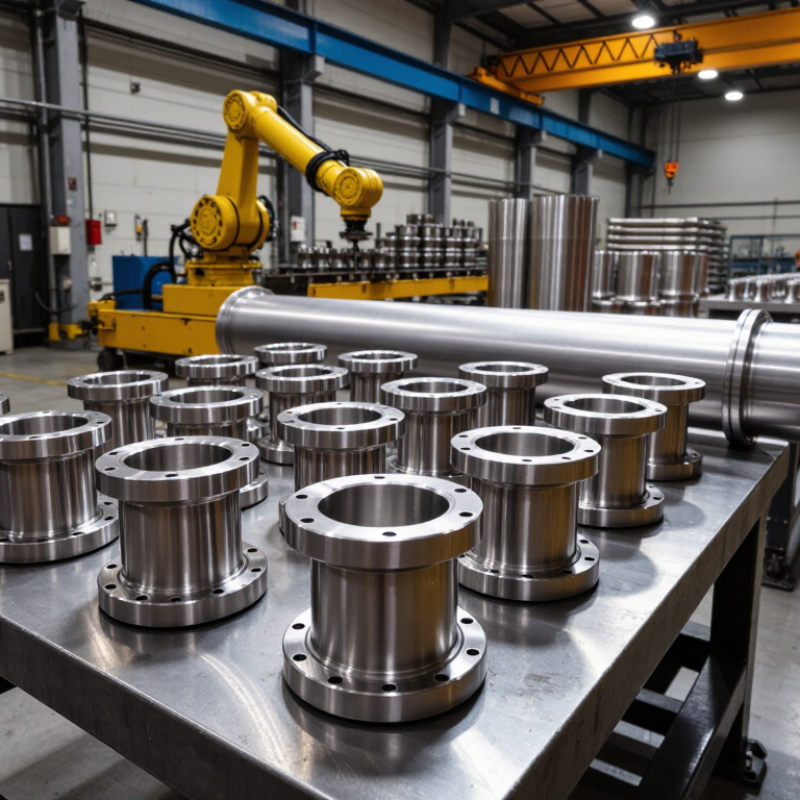
Concentric Reducer Fittings: Definition, Design, and Main Applications
Concentric reducer fittings connect pipes with different diameters along one common centerline. Their cone-shaped body reduces flow size gradually, unlike an eccentric reducer with offset centers. This geometry supports balanced loading and compact installation. It is widely used in water treatment, chemical processing, power generation, and general industrial piping.
A reliable design considers pressure, temperature, fluid velocity, corrosion risk, and wall thickness. Engineers typically select stainless steel, carbon steel, or alloy materials according to service conditions. The fitting should match the pipe schedule and connection type precisely. Poor alignment can create stress at the weld. Small errors matter.
In practical installation, concentric reducers often serve vertical lines, pump discharge sections, and process pipelines where air removal is not a concern. They can also simplify layout changes in crowded plant rooms. However, the shape may trap air in some horizontal liquid systems. That detail is easy to miss. Experienced manufacturers control forming accuracy, heat treatment, dimensional tolerances, and surface quality during production. Inspection may include visual checks, material verification, and non-destructive testing. No design is perfect. Engineers still need to review flow behavior and maintenance access before approval.
| Evaluation Dimension | Industry-Standard Data | Technical Description | Typical Applications | What to Verify from a Manufacturer |
|---|---|---|---|---|
| Fitting Definition | Butt-welding pipe fitting with a common centerline | A concentric reducer connects a larger pipe to a smaller pipe while keeping the longitudinal axis aligned. The gradual taper helps provide a compact and symmetrical transition. | Process piping, utility piping, water systems, power generation and industrial plants | Dimensional conformity, end preparation, concentricity and traceability of raw material |
| Primary Design Standards | ASME B16.9 MSS SP-75 EN 10253-2 JIS B2313 | ASME B16.9 covers factory-made wrought butt-welding fittings. MSS SP-75 is commonly used for high-strength wrought butt-welding fittings. EN 10253-2 and JIS B2313 provide widely used European and Japanese dimensional and technical requirements. | International oil and gas projects, chemical plants, European installations and Asian industrial projects | Standard edition, dimensional tables, tolerance requirements and project-specific compliance |
| Size Range | Commonly NPS 1/2 to NPS 48 or larger; DN 15 to DN 1200 or larger | Available size ranges vary by manufacturing process, material grade, wall thickness and applicable standard. Large-diameter fittings are often produced as welded or specially formed components. | Small-bore instrument and utility lines through large-diameter transmission and plant piping | Available outside diameters, nominal sizes, wall thicknesses and custom dimensions |
| Typical Materials | ASTM A234 WPB ASTM A403 WP304/316 ASTM A420 WPL6 ASTM A860 WPHY | Carbon steel is widely used for general process piping. Austenitic stainless steel supports corrosive or hygienic service. Low-temperature carbon steel and high-yield-strength grades are selected for specialized operating conditions. | Hydrocarbon processing, chemical service, cryogenic or low-temperature systems, and high-pressure transmission piping | Material certificates, chemical composition, mechanical properties, heat treatment and impact-testing requirements |
| Manufacturing Methods | Hot forming, cold forming, seamless production and welded construction | Seamless fittings are formed from seamless pipe or billet, while welded fittings may use plate or welded pipe. Forming and heat treatment must be controlled to meet the specified material and dimensional requirements. | Standard process piping, high-pressure services, large-diameter piping and corrosion-resistant systems | Process qualification, forming temperature control, weld procedure qualification and heat-treatment records |
| End Preparation | Beveled butt-welding ends | Butt-welding ends are normally prepared with an outside diameter, wall-thickness and bevel geometry suitable for welding to matching pipe. The exact preparation depends on the governing standard and wall thickness. | Permanent welded joints where leak resistance and structural integrity are required | Bevel angle, root face, outside diameter, wall-thickness tolerance and surface condition |
| Pressure and Temperature Design | Determined by material, wall thickness, design temperature and piping code | Butt-welding fittings generally do not use a single universal pressure rating independent of the piping system. Allowable pressure depends on the fitting material, dimensions, temperature and the applicable design code. | Refineries, power plants, chemical processing units and high-pressure pipelines | Design calculations, pressure-temperature data, code compliance and project pressure class requirements |
| Quality Inspection | Visual, dimensional, chemical, mechanical and non-destructive examination | Common controls include visual inspection, dimensional inspection, hardness testing, tensile testing, hydrostatic or other specified testing, and non-destructive examination such as radiography, ultrasonic testing, magnetic-particle testing or liquid-penetrant testing. | Safety-critical piping, sour-service systems, high-pressure lines and regulated projects | Inspection and test plan, NDE personnel qualifications, test reports, calibration records and material traceability |
| Surface Treatment | Blasting, pickling and passivation, painting or protective coating | Carbon-steel fittings may receive cleaning, blasting, painting or temporary corrosion protection. Stainless-steel fittings may require pickling and passivation to restore corrosion resistance after forming or heat treatment. | Outdoor pipelines, marine environments, chemical plants and hygienic or corrosion-sensitive systems | Surface preparation grade, coating system, dry-film thickness, passivation procedure and packaging protection |
| Main Applications | Oil and gas Petrochemical Chemical Power Water treatment Marine | The fitting is used where a centered, gradual change in pipe diameter is preferred. Its symmetrical profile is suitable for many horizontal or vertical piping arrangements. | Fluid transfer lines, pump and compressor piping, process units, cooling-water systems and utility headers | Service compatibility, flow direction, installation orientation, corrosion allowance and project specifications |
| Concentric vs. Eccentric Design | Concentric: aligned centerline; Eccentric: offset centerline | Concentric reducers are suitable when a symmetrical transition is acceptable. Eccentric reducers are often selected to maintain a flat pipe elevation, prevent liquid accumulation or avoid gas-pocket formation in specific layouts. | Concentric: vertical lines and general transitions; eccentric: pump suction, horizontal liquid lines and drainage-sensitive systems | Engineering layout, flow-phase behavior, installation orientation and the project piping specification |
| Documentation Package | Material test certificate, dimensional report and inspection records | A complete supply package may include a certificate of conformity, heat-number traceability, chemical and mechanical test results, NDE reports, heat-treatment charts, coating records and packing lists. | Turnkey projects, regulated industries, export orders and quality-controlled construction | Document completeness, heat-number consistency, applicable standard, revision control and third-party inspection acceptance |