Blog
China Top 10 Maize Flour Mill Machine Manufacturers?
Maize remains a major food and industrial crop, making dependable milling equipment important to processors of many sizes. FAOSTAT reports global maize production of roughly 1.16 billion tonnes in 2022. The USDA Foreign Agricultural Service’s Production, Supply and Distribution database also tracks maize output, trade, and use across markets. These figures describe a large, active supply chain—not a guarantee that every mill will succeed.
A Maize Flour Mill Machine must handle the crop consistently, from cleaning and conditioning through grinding and sieving. Buyers should compare hourly capacity, flour fineness, power use, automation, spare-parts access, and installation support. Ask for test results using maize similar to your own. A polished catalogue is not enough. Dust control and ease of cleaning matter on the factory floor, too.
This guide examines ten Chinese manufacturers through practical criteria: product range, engineering capability, documented experience, and after-sales service. China has a broad machinery sector, but company claims can be difficult to compare. A ranking can still miss important differences between a small local mill and a complete industrial line. That deserves caution. Treat published capacities as starting points, then confirm them with technical documents and customer references. The right supplier is not automatically the largest or cheapest. It is the one whose equipment fits your grain, output target, site conditions, and maintenance skills.
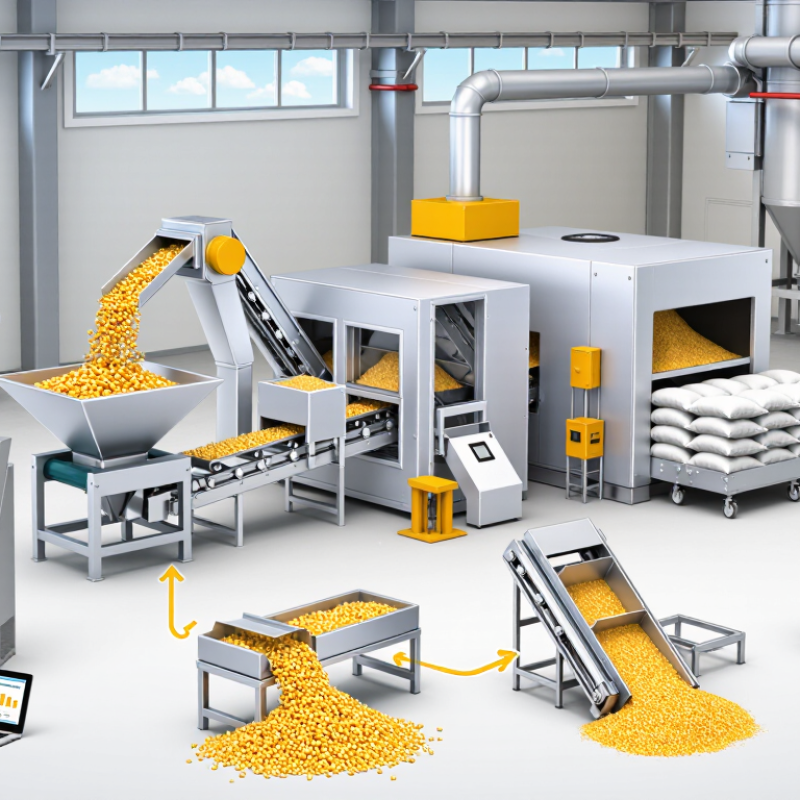
How Maize Flour Milling Works: Cleaning, Conditioning, Degermination, and Sifting
Maize flour milling begins with cleaning, since field dust, cob fragments, and stones can damage equipment or discolor the finished flour. Screens remove larger debris, while aspiration draws away lighter chaff. A destoner separates dense particles, and magnets can catch stray metal. Small details matter. Operators should check the cleaned grain rather than assume one setting suits every harvest.
Conditioning adds a measured amount of water and gives kernels time to rest. This softens the outer layers and helps the endosperm separate from the germ during degermination. The target depends on grain moisture, hardness, and the intended flour. Degermination reduces oil-rich germ in the flour stream, which can support a longer shelf life, but excessive removal also wastes useful material. That takes adjustment. After milling, sifters separate flour by particle size; coarser fractions may return for another pass. Flour texture is not decided by the mill alone. Screen condition, feed rate, and uneven kernels all matter. In practice, settings need regular checks, and some batches behave differently than expected.
What Mill Capacities Do Chinese Manufacturers Offer, Measured in Tonnes per Day?
Chinese maize flour mill suppliers commonly quote capacities from 5 to 500 tonnes per day. Small plants may process 5–20 tonnes daily, while medium lines often fall between 30 and 100 tonnes. Larger integrated plants can reach 150–500 tonnes, depending on configuration. These are practical equipment ranges, not a verified national ranking or a guarantee of output.
For scale, the USDA Foreign Agricultural Service’s June 2024 Grain: World Markets and Trade report estimated 2023/24 global corn production at about 1.23 billion tonnes. That figure describes grain supply, not flour-milling capacity. A machine’s daily rating usually means maize input under stated operating conditions. Ask whether the quote assumes 24-hour operation, and check grain moisture, cleaning losses, and flour extraction rate.
Details matter. A line rated at 100 tonnes per day may produce less saleable flour when maize quality varies or downtime rises. I would compare guaranteed test-run results, power use, and staffing needs—not capacity alone. The rating can mislead.
How to Compare 10 Chinese Manufacturers by Yield, Automation, and After-Sales Service
Comparing ten Chinese maize flour mill machine manufacturers starts with a fair yield test. Ask each supplier to process the same maize variety at similar moisture levels. Record hourly output, flour fineness, and the amount of bran or broken grain. Numbers need context. A machine rated for high capacity may produce less when grain quality changes or cleaning takes longer. Request a witnessed trial and keep the operating conditions on record.
Automation should be judged by daily tasks, not just a control panel. Check whether sensors monitor feeding, temperature, and machine load. Ask how quickly an operator can adjust settings for a different flour texture. A practical test is to observe a full shift, including startup and shutdown. Count manual adjustments and note where flour gathers around chutes. Small details matter. A polished demonstration may not reflect routine production, so consider that limitation.
After-sales service needs equally concrete checks. Ask for written response times, spare-parts availability, installation support, and operator training. Contact existing users, if possible, and ask how long common repairs took. Compare warranty terms carefully; coverage can exclude parts that wear through normal use. A spreadsheet helps, but it can hide differences in test conditions. Keep the assumptions visible, and verify key promises before comparing final offers.
Which Quality Benchmark Matters? Codex Sets a 15% Maximum Moisture for Maize Flour
China Top 10 Maize Flour Mill Machine Manufacturers?
Moisture is a practical benchmark when evaluating maize flour quality. Codex Alimentarius Standard CXS 154-1985 sets a maximum moisture content of 15.0% for maize flour. It also notes that lower limits may be needed for particular destinations or climatic conditions. This matters on the production floor: flour leaving a mill at 14.9% has little room for moisture pickup during cooling, packing, or storage. Small differences matter.
A moisture result is only useful when the sampling and test method are reliable. ISO 712:2009 describes a reference method for determining moisture in cereals and cereal products. For mill audits, representative samples should be taken from different points in a batch, not just from the top of one sack. Record the test method, sample location, and result together. Otherwise, a single number can look more certain than it really is.
The 15% figure is a maximum, not a recommended operating target for every mill. A plant may set a lower internal limit to allow for local humidity and transport time, then verify it with routine testing. Moisture alone cannot prove overall flour quality; particle size, cleanliness, and storage conditions also matter. And a neat lab result can still miss a poorly mixed batch. Sources: Codex Alimentarius CXS 154-1985; ISO 712:2009.
China Top 10 Maize Flour Mill Machine Manufacturers? - Which Quality Benchmark Matters? Codex Sets a 15% Maximum Moisture for Maize Flour
This table provides ten practical criteria for comparing maize flour milling equipment suppliers without naming companies or brands. The Codex moisture limit applies to the flour product, not to the milling machine; other equipment checks below are procurement considerations, not universal Codex limits.
| No. | Comparison Dimension | Benchmark or Evidence to Request | Why It Matters | Benchmark Type |
|---|---|---|---|---|
| 1 | Finished-flour moisture | For maize flour covered by Codex CXS 154-1985, the maximum moisture content is 15.0%. The standard gives a 15.5% maximum for whole maize flour. | Moisture affects product stability and should be checked on representative finished-product samples using a suitable test method. | Codex product standard |
| 2 | Flour particle-size performance | Request the supplier’s stated particle-size distribution and test results for the specific product and sieve specification required by the buyer. | Particle size influences flour use, texture, and consistency. Requirements depend on the intended product and applicable market rules. | Application-specific specification |
| 3 | Processing capacity | Ask for guaranteed input capacity in tonnes per hour and clarify maize condition, moisture, operating hours, and which equipment is included. | Capacity figures are meaningful only when operating conditions and the scope of the quoted line are clearly defined. | Supplier guarantee to verify |
| 4 | Cleaning and foreign-material removal | Review the proposed cleaning stages and request a process-flow diagram showing how stones, metal, dust, and other foreign material are addressed. | Effective cleaning protects downstream equipment and supports hygienic production. | Equipment and process review |
| 5 | Food-contact materials | Request documentation identifying materials used on product-contact surfaces and evidence of suitability for the intended food-processing application. | Material suitability, cleanability, and corrosion resistance contribute to safe, maintainable processing. | Documentation and inspection |
| 6 | Dust control and ventilation | Check the dust-collection layout, extraction points, filter maintenance requirements, and applicable workplace and fire-safety provisions. | Maize milling produces dust; control measures support housekeeping, worker safety, and reliable operation. | Site-specific safety review |
| 7 | Energy consumption | Request rated motor power and, where available, measured energy use per tonne under stated production conditions. | Comparable operating data helps estimate production costs; rated motor power alone does not show actual energy use. | Test data and operating records |
| 8 | Product-contact cleaning and maintenance | Review access for inspection and cleaning, wear-part replacement procedures, maintenance intervals, and the recommended spare-parts list. | Maintainability affects downtime, hygiene routines, and the long-term cost of operation. | Design review and service documentation |
| 9 | Performance acceptance testing | Agree in writing on the test material, operating conditions, sampling plan, throughput, product specifications, and acceptance procedure before purchase. | A documented test makes supplier performance claims easier to assess and compare. | Contractual acceptance criteria |
| 10 | Installation, training, and after-sales support | Confirm installation scope, operator training, technical documentation, warranty terms, response arrangements, and availability of critical spare parts. | Support arrangements can affect commissioning time and equipment availability after installation. | Contract and service review |
How to Match Mill Configurations to Flour, Grits, and Germ Products
Matching a maize mill to its products begins with the buyer’s sieve targets, not the machine’s headline capacity. USDA Foreign Agricultural Service’s Production, Supply and Distribution database estimated world corn output at roughly 1.2 billion tonnes in 2023/24. FAO’s Cereal Supply and Demand Brief reported a similar scale. These figures show the crop’s importance, but they cannot predict a plant’s yield.
For fine flour, a line may combine cleaning, conditioning, roller milling, and plansifting. For grits, dehulling and degermination help separate larger endosperm pieces from bran and germ. Germ recovery also depends on kernel condition and careful aspiration. Small settings matter. A few broken kernels can send extra starch into the germ stream.
Buyers should request trial results using their own maize, with moisture, sieve fractions, and product purity recorded. Specify whether flour, grits, or germ has priority; one configuration rarely maximizes all three. Check screen sizes, airflow controls, and access for cleaning before comparing tonnes per hour. A practical caution: catalogue yields are not guarantees. Local maize varies, and I would retest after changing varieties or moisture levels.
China Top 10 Maize Flour Mill Machine Manufacturers? — How to Match Mill Configurations to Flour, Grits, and Germ Products
Typical maize kernel composition helps guide dry-milling choices: degermination and sifting separate germ and bran, while endosperm is processed into grits and flour. These approximate kernel fractions are not guaranteed product yields; results vary with maize variety, moisture, and mill settings.