Blog
What Is a Welded Pipe and What Types Are Available?
Welded Pipe is manufactured by forming steel, stainless steel, or another metal into a tube and joining its edges with heat. Unlike seamless pipe, it contains a visible or controlled weld seam. That seam is not automatically a weakness. Modern production uses precise forming, welding, and inspection equipment to achieve consistent quality.
Several types serve different engineering needs. Longitudinally welded pipe has a straight seam running along its length. It is common in water systems, structural projects, and process lines. Spiral Welded Pipe uses a helical seam and can efficiently produce large diameters. Electric resistance welded pipe, often called ERW pipe, is widely used for oil, gas, construction, and general industrial service. Stainless welded pipe offers strong corrosion resistance, especially in food processing, chemical plants, and coastal environments.
Choosing the right type requires more than comparing prices. Wall thickness, outside diameter, pressure, temperature, fluid chemistry, and installation conditions all matter. Relevant standards, such as ASTM, API, or EN specifications, should be checked with the project requirements. Experienced inspectors also examine weld appearance, dimensional accuracy, non-destructive test records, and material certificates. Small defects can become serious under vibration or repeated pressure.
The distinction is not always tidy. Some applications overlap.
A pipe suitable for water may fail in a corrosive chemical service. Weld quality also depends on manufacturing control, not only the pipe category. This guide explains how each Welded Pipe type is made, where it performs well, and which limitations deserve careful attention before purchasing or installation.
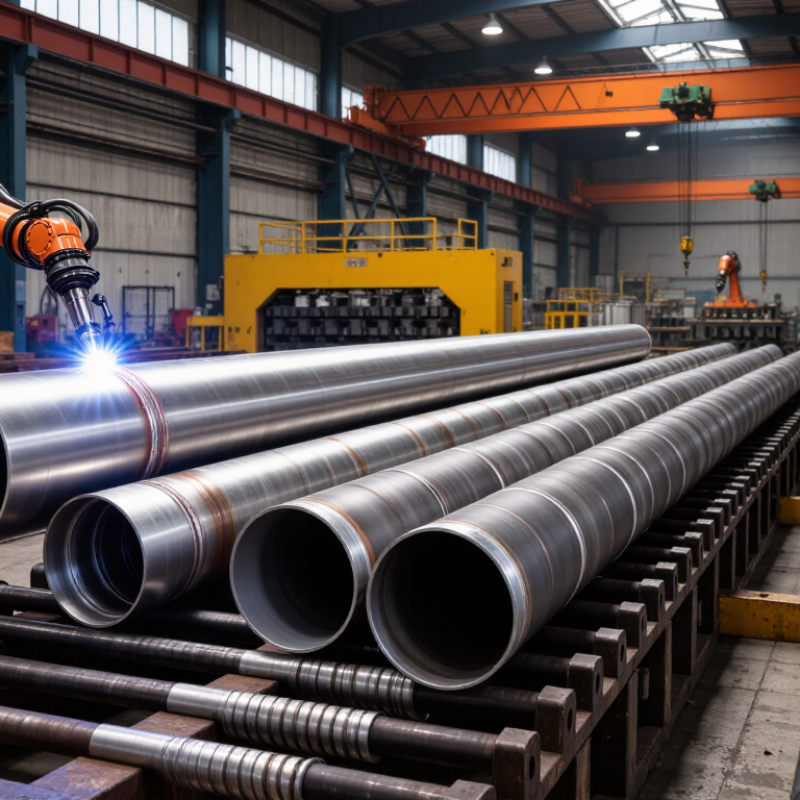
What Is a Welded Pipe?
A welded pipe is a steel tube made by forming flat strip or plate and joining its edges. The joint becomes a visible seam, either longitudinal or spiral. Electric resistance welding uses heat and pressure from electrical current. Submerged arc welding uses an arc beneath granular flux. These processes suit different wall thicknesses, diameters, and service conditions. The choice is not merely about price.
Welded pipes are widely used in water systems, structural columns, industrial lines, and energy infrastructure. The World Steel Association’s 2024 Short Range Outlook forecast global steel demand growth of 1.7% in 2024 and 1.2% in 2025. That trend supports continued pipe demand, although it does not measure welded pipe alone. Engineers still check weld quality, dimensional tolerance, corrosion allowance, and pressure requirements. Ultrasonic testing, hydrostatic testing, and visual inspection can reveal incomplete fusion or surface defects.
The seam matters.
Common types include electric resistance welded pipe, high-frequency welded pipe, and submerged arc welded pipe. Spiral-welded pipe can produce large diameters from narrower steel coils. However, a welded pipe is not automatically weaker than a seamless pipe. Performance depends on steel grade, welding control, heat treatment, and inspection records. Poorly specified material can fail in service. That uncomfortable detail deserves attention. Configuration, operating temperature, and installation quality must guide selection.
What Is a Welded Pipe and What Types Are Available?
Welded pipe is manufactured by forming steel strip or plate into a cylindrical shape and joining the edges along a seam. Common types include electric resistance welded (ERW), longitudinal submerged arc welded (LSAW), and spiral submerged arc welded (SSAW) pipe.
The chart shows standard outside diameters for selected nominal pipe sizes commonly used when specifying welded steel pipe. The dimensional values are based on ASME B36.10M standard steel pipe dimensions. Actual wall thickness, grade, seam type, and manufacturing process depend on the intended service.
How Are Welded Pipes Manufactured?
Welded pipes begin as steel coils or flat plates, not as hollow tubes. Manufacturers unwind the material, level it, and cut it to a controlled width. Forming rollers gradually bend the strip into a round shape. The edges meet along one seam. Electrical resistance heating then softens the edges, while pressure joins them continuously. This process is common for electric resistance welded and high-frequency welded pipes. The weld bead may be trimmed inside and outside.
Larger diameters often use plate-forming methods. The plate can be shaped into a cylinder and welded with submerged arc equipment. Some pipes use a longitudinal seam, while others use a spiral seam. Each design suits different diameter, thickness, and pressure requirements. After welding, technicians inspect the seam with ultrasonic or radiographic testing. Hydrostatic testing may follow, using water to check for leakage under controlled pressure. Dimensions, surface condition, and chemical composition also require verification. Coatings are applied later when corrosion protection is needed.
The process looks precise. It is not flawless. Small changes in edge alignment, heat input, or welding speed can affect seam quality. Experienced inspectors therefore review process records, test results, and cut sections rather than trusting appearance alone. That practical discipline helps determine whether an ERW, longitudinal submerged arc, or spiral welded pipe fits the intended service.
What Are the Main Types of Welded Pipes?
Welded pipe is made by forming steel strip or plate and joining the seam with heat, pressure, or both. Its main types differ by welding method, seam direction, and manufacturing scale. Electric resistance welded pipe, often called ERW pipe, has a straight seam. It suits water lines, structural work, and many medium-pressure applications. The process is efficient, but seam quality depends heavily on edge preparation and heat control.
Longitudinal submerged arc welded pipe, or LSAW pipe, is formed from a wide plate with a straight longitudinal seam. It is commonly selected for large diameters, demanding pipelines, and high-pressure service. Spiral submerged arc welded pipe, known as SSAW pipe, uses a helical seam and can produce large diameters from narrower steel coils. It may offer production flexibility, although engineers must review stress patterns, coating needs, and inspection results carefully. The choice is not always obvious. Soil movement and temperature changes can alter the real service demands.
Tips: Check the required diameter, wall thickness, pressure rating, and fluid temperature before ordering. Ask for material certificates, weld inspection records, and dimensional reports. Verify standards with a qualified engineer. A cheaper pipe can become expensive when repairs, installation delays, or premature corrosion appear.
Which Materials and Welding Methods Are Used?
What Is a Welded Pipe and What Types Are Available?
Which Materials and Welding Methods Are Used?
Welded pipe begins with flat steel strip or plate, formed into a round shape and joined along a seam. Carbon steel remains common because it offers strength, availability, and manageable fabrication costs. The World Steel Association reported 1.892 billion tonnes of crude steel production in 2023. That scale supports steady access to pipe-making feedstock. Stainless steel is selected for corrosion resistance, especially in chemical, food, and coastal service. Duplex stainless steel adds strength, but fabrication demands tighter heat control. Nickel alloys suit severe environments, although their cost can change project decisions quickly.
Electric resistance welding, or ERW, uses electrical heat and pressure along the seam. It is efficient for many smaller and medium diameters. High-frequency welding improves production speed, but operators must still inspect the heat-affected zone. Submerged arc welding, or SAW, uses a granular flux and a continuously fed wire. It is widely used for larger diameters and heavier walls. Spiral SAW forms the pipe helically, while longitudinal SAW follows a straight seam. ISO 3183 and API 5L specify important requirements for line pipe, including testing and acceptance criteria. Standards help, but field conditions can expose weaknesses that factory data cannot predict.
Tips: Match the material to the fluid, temperature, pressure, and corrosion risk. Ask for mill certificates, weld procedure records, and ultrasonic inspection results. Do not judge quality from a smooth surface alone. Even experienced teams sometimes underestimate residual stress and installation loads. That deserves another review.
What Is a Welded Pipe and What Types Are Available? - Which Materials and Welding Methods Are Used?
| Welded Pipe Type | Manufacturing Principle | Common Materials | Typical Welding Method | Key Characteristics | Typical Applications |
|---|---|---|---|---|---|
| Electric Resistance Welded (ERW) | A flat strip is formed into a cylindrical shape, and the abutting edges are joined by heat generated from electrical resistance and applied pressure. | Carbon steel, low-alloy steel, stainless steel, and selected high-strength steels. | High-frequency resistance welding (HFW) or conventional electric resistance welding. | High production speed, consistent dimensions, and a longitudinal seam. The weld area may require heat treatment or inspection depending on the service. | Water lines, structural components, mechanical tubing, low- to medium-pressure service, and oil and gas line pipe. |
| Longitudinal Submerged Arc Welded (LSAW) | A steel plate is formed into a pipe, usually by U-ing and O-ing or press forming, before the longitudinal seam is welded. | Carbon steel and low-alloy steel, including grades designed for pipeline and structural service. | Submerged arc welding (SAW), commonly performed from the inside and outside of the seam. | Suitable for large diameters and heavy wall thicknesses. The weld is shielded by granular flux, helping protect the molten metal from atmospheric contamination. | Large-diameter water transmission, oil and gas pipelines, piling, pressure-related construction, and heavy structural work. |
| Spiral Submerged Arc Welded (SSAW) | A steel strip is helically formed around a cylindrical mandrel, creating a spiral seam along the pipe length. | Carbon steel and low-alloy steel. | Submerged arc welding, generally with the seam welded on the inside and outside. | Efficient for producing large-diameter pipe from coiled plate or strip. The helical seam requires appropriate design and inspection for demanding services. | Water pipelines, slurry lines, piling, drainage, and low- to moderate-pressure transportation systems. |
| Gas Metal Arc Welded (GMAW/MIG) | A continuously fed consumable wire electrode forms the weld while an external shielding gas protects the arc and molten pool. | Carbon steel, stainless steel, aluminum, and selected nickel alloys. | Gas metal arc welding; short-circuit, spray, or pulsed transfer may be selected for the material and thickness. | Flexible and productive, with good automation potential. Shielding gas makes the process sensitive to wind and surface contamination. | Fabricated pipe assemblies, maintenance work, structural tubing, process piping, and general manufacturing. |
| Gas Tungsten Arc Welded (GTAW/TIG) | A non-consumable tungsten electrode produces the arc; filler metal may be added separately when required. | Stainless steel, carbon steel, aluminum, titanium, nickel alloys, and other weldable metals. | Gas tungsten arc welding, often used for root passes or thin-wall precision pipe. | Excellent control and clean, high-quality welds with low spatter. It is slower than many wire-fed processes. | Food and pharmaceutical piping, chemical processing, semiconductor systems, high-purity service, and critical root welds. |
| Flux-Cored Arc Welded (FCAW) | A tubular wire containing flux produces the weld; the process may use external shielding gas or self-shielding flux. | Carbon steel, low-alloy steel, stainless steel, and certain wear-resistant alloys. | Gas-shielded or self-shielded flux-cored arc welding. | High deposition rate and good penetration, especially for thicker sections. Slag removal is normally required between passes. | Heavy fabrication, construction, repair work, structural pipe, and outdoor welding where self-shielded wire is suitable. |
| Stainless Steel Welded Pipe | Produced from stainless strip or plate and formed into a tube before the longitudinal or spiral seam is welded. | Austenitic, ferritic, martensitic, and duplex stainless steels. | TIG, plasma arc, laser, high-frequency resistance, or submerged arc welding, depending on thickness and product design. | Good resistance to corrosion and oxidation. Weld procedures must control heat input and may require cleaning or post-weld treatment. | Food processing, chemical plants, water treatment, architectural systems, heat exchangers, and sanitary piping. |
| Aluminum Welded Pipe | Aluminum strip or plate is formed and joined while managing the material's high thermal conductivity and oxide layer. | Wrought aluminum alloys selected for strength, corrosion resistance, or formability. | GTAW/TIG, GMAW/MIG, laser welding, or friction-based processes for suitable designs. | Low density and good corrosion resistance. Welding requires careful oxide removal, heat control, and filler selection. | Transportation, marine systems, compressed-air lines, heat-transfer equipment, and lightweight structures. |
| Plastic Welded Pipe | Thermoplastic pipe ends or fittings are heated and fused, creating a joint without a metal weld seam. | High-density polyethylene (HDPE), polypropylene (PP), polyvinyl chloride (PVC), and related thermoplastics. | Butt fusion, electrofusion, socket fusion, or extrusion welding, according to the polymer and joint design. | Lightweight and corrosion-resistant. Temperature, pressure, chemical compatibility, and installation conditions limit service selection. | Water distribution, gas distribution, wastewater, chemical handling, irrigation, and industrial fluid systems. |
Where Are Welded Pipes Used and How Are They Selected?
Welded pipes are made by joining steel strip or plate along a controlled seam. They serve water systems, construction frames, drainage networks, and process facilities. In water treatment plants, they may carry clean water, chemicals, or wastewater. On outdoor pipe racks, large pipes face sunlight, rain, vibration, and accidental impact. The service environment matters more than appearance.
Pipe selection starts with flow rate, working pressure, temperature, and required diameter. Engineers also review wall thickness, steel grade, weld quality, and applicable standards. Electric resistance welded pipes suit many moderate-pressure applications with consistent dimensions. Spiral welded pipes can support large diameters, especially in water transmission and piling work. Longitudinal submerged arc welded pipes may be chosen for demanding, heavy-wall service. The best option depends on verified operating data.
Corrosion deserves close attention. Moist coastal air can attack an unprotected external surface surprisingly quickly. Internal linings may help when the conveyed fluid is aggressive. Field teams should inspect welds, measure wall thickness, and review testing records before installation. I would not treat a catalog table as a final decision. A small error in pressure data can create an expensive redesign. Even a strong pipe may fail when supports, expansion, or drainage are poorly planned.