Blog
Top Heavy Duty Racking Systems for Global Buyers
Choosing a heavy duty racking system is a strategic decision for global buyers. It affects storage density, worker movement, product protection, and future expansion. A strong system must carry demanding loads without creating unnecessary handling risks.
According to warehouse consultant James R. Tompkins, “A warehouse is not a place to store inventory; it is a place to manage inventory.” This principle remains practical. Racking should support accurate stock control, not merely fill available floor space. Selective pallet racks may suit varied products and frequent access. Drive-in racks can increase density, but they require disciplined loading and unloading. Double-deep systems save space, although they may reduce direct access.
Real projects reveal details that product brochures often miss. Uneven concrete can complicate installation. Forklift turning distances may be underestimated. Fire protection requirements can also change the usable rack height. These issues deserve attention before purchasing.
Load capacity must be calculated from actual pallet weights, dimensions, beam levels, and handling equipment. Local engineering standards should guide design, inspection, anchoring, and maintenance. Global buyers also need clear documentation, replacement-part availability, and dependable technical support.
Some decisions remain imperfect. Maximum density is not always the best value. A cheaper rack may create slower picking or higher damage rates later. Buyers should compare total operating costs, not only the initial quotation. The right heavy duty racking system is the one that safely supports today’s workflow and tomorrow’s uncertainty.
Heavy Duty Racking Systems: Definition, Purpose, and Core Features
Top Heavy Duty Racking Systems for Global Buyers
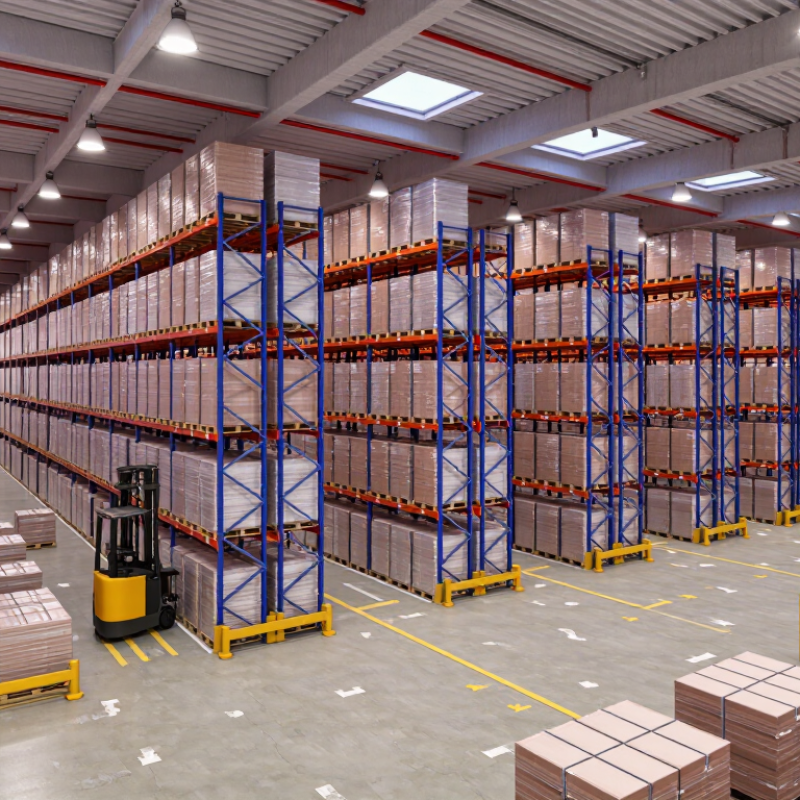
Heavy duty racking systems are engineered storage structures for dense, palletized goods. They use steel uprights, horizontal beams, bracing, and adjustable levels. Their purpose is clear: increase vertical capacity while keeping aisles accessible for handling equipment. A typical installation may turn a six-metre ceiling into several usable storage tiers. That matters.
Core features include declared load ratings, beam locks, upright protection, floor anchoring, and visible safety labels. Professional designers also assess pallet dimensions, forklift reach, slab strength, seismic exposure, and loading frequency. According to the 2024 MHI Annual Industry Report, 55% of supply-chain leaders planned to increase technology and innovation investment. Racking should support that investment, not obstruct it.
Safety depends on disciplined use. Operators must inspect damaged frames, displaced beams, and overloaded levels. The European standard EN 15635 recommends regular inspections and recorded corrective actions. However, a standard cannot replace site judgment. A rack designed for uniform pallets may perform poorly with uneven loads. Small errors grow. Buyers should request engineering calculations, installation records, corrosion protection details, and maintenance guidance. The cheapest quotation may exclude critical protections, creating higher costs later. Even experienced teams can overlook changing forklift routes or new product weights. Recheck the design when operations change.
Main Types of Heavy Duty Racking Systems for Different Storage Needs
Heavy duty racking systems serve different storage needs, so the right choice depends on load size, access frequency, and available floor space. Selective pallet racking offers direct access to every pallet. It suits warehouses with many stock keeping units and frequent picking. Adjustable beams also help when pallet heights change. However, it may consume more aisle space than expected.
Drive-in racking stores pallets deeply within continuous lanes. It works well for large quantities of similar products with limited rotation. Push-back racking uses nested carts and supports several pallets per lane. It improves density while preserving front access. Double-deep racking stores one pallet behind another, but it requires suitable handling equipment and stricter stock planning. This point is often underestimated.
Cantilever racking is designed for long, oversized materials such as pipes, timber, and metal sections. Its open front makes loading easier, especially when product lengths vary. Warehouse managers should inspect floor strength, beam capacity, aisle clearance, and impact protection before installation. I have seen layouts fail because storage volume was valued above safe movement. More capacity is not always better. Regular inspections matter. Damaged uprights, loose connections, or overloaded beams can create serious operational risks. A careful site survey, accurate load data, and realistic workflow testing usually produce a more reliable system. Even experienced teams sometimes revise the design after observing real picking behavior.
Top Heavy Duty Racking Systems for Global Buyers - Main Types of Heavy Duty Racking Systems for Different Storage Needs
| Racking System | Typical Load per Pallet Position | Typical System Height | Space Utilization | Stock Rotation | Forklift or Handling Requirement | Best Storage Application | Main Advantages | Key Limitations |
|---|---|---|---|---|---|---|---|---|
| Selective Pallet Racking | 500–5,000 kg | 3–12 m | Low to medium; usually about 35–50% of floor area used for storage | Excellent; direct access to every pallet | Counterbalance, reach, or articulated forklift; aisle width commonly 2.7–3.5 m depending on equipment | Warehouses with many SKUs, mixed pallet sizes, and frequent picking | Highly flexible, easy inventory control, simple beam adjustment, and relatively low initial complexity | Requires more aisles than high-density systems and may provide lower storage density |
| Double-Deep Pallet Racking | 500–4,500 kg | 4–12 m | Medium to high; commonly 10–25% more pallet positions than single-deep selective layouts | Good for two-pallet-deep inventory; limited direct access to rear pallets | Reach truck with a double-deep attachment or suitable telescopic forks; aisle width commonly 2.8–3.5 m | Medium-volume SKUs where each product has several pallets in reserve | Improves density while retaining access to a substantial number of pallet locations | Requires inventory discipline; rear pallets are less accessible and may need the front position to be cleared first |
| Drive-In Racking | 500–2,000 kg | 4–10 m | High; reduces aisle space and can store several pallets deep | Generally LIFO; FIFO is possible only with drive-through configuration | Counterbalance or reach forklift with careful tunnel alignment; no standard cross-aisles inside the block | Large quantities of a small number of SKUs, such as cold storage or batch inventory | High pallet density, effective use of building volume, and reduced aisle requirements | Limited selectivity, slower access, greater risk of rack impact, and less suitable for many-SKU operations |
| Push-Back Pallet Racking | 500–1,500 kg | 4–10 m | High; typically stores 2–6 pallets deep per lane | LIFO; each lane normally holds one SKU | Standard counterbalance or reach forklift; pallets move on nested carts or inclined rails | High-density storage with several pallets per SKU and moderate product turnover | Good density, fewer aisles than selective racking, and faster loading and retrieval than drive-in systems | Not ideal for strict FIFO, product assortment is limited by lane, and carts or rails require inspection |
| Pallet Flow Racking | 500–1,500 kg | 4–10 m | High; deep lanes use gravity rollers to reduce aisle space | FIFO; pallets are loaded from one side and picked from the opposite side | Forklift for loading and order picking equipment at the dispatch face; controlled-speed rollers are required | Perishable goods, date-sensitive products, and high-throughput distribution operations | Strong stock rotation, reduced travel distance, and clear separation of loading and picking activities | Higher investment, lane-specific SKU planning, and regular maintenance of rollers and brakes |
| Mobile Pallet Racking | 500–4,000 kg | 3–12 m | Very high; one or a small number of aisles can serve many rack rows | Excellent when opened; direct access to stored pallets | Conventional forklift; motor-driven rack bases require floor tracks, safety controls, and aisle management | Cold rooms, archives, high-cost floor areas, and warehouses requiring high selectivity and density | Combines near-selective access with high space utilization and can reduce required building volume | Higher capital cost, slower access when another aisle is open, and greater dependence on controls and maintenance |
| Very Narrow Aisle (VNA) Racking | 500–2,000 kg | 8–18 m | High; narrow aisles and tall structures maximize cubic capacity | Excellent; direct access to most pallet positions | VNA turret truck or guided man-up truck; aisle width commonly about 1.5–2.0 m | High-throughput facilities with high ceilings, many SKUs, and accurate location control | High storage density and selectivity with strong use of vertical space | Requires specialized equipment, precise floor flatness, guidance systems, and higher operator training |
| Pallet Shuttle Racking | 500–1,500 kg | 4–12 m | Very high; deep lanes can be used with minimal forklift travel inside the rack | FIFO or LIFO depending on lane and operating configuration | Forklift transfers a battery-powered shuttle into each lane; remote control or warehouse software may be used | High-volume, low-SKU or batch storage, including temperature-controlled facilities | High density, improved operator safety, reduced forklift travel, and faster deep-lane handling | Higher system cost, dependence on shuttle equipment and batteries, and reduced suitability for highly mixed SKUs |
| Automated Storage and Retrieval System (AS/RS) for Pallets | 500–1,500 kg | 8–30 m or more, subject to engineering and building conditions | Very high; tall structures and narrow aisles maximize cubic storage capacity | Excellent when integrated with inventory-control software; FIFO or LIFO can be configured | Automated stacker crane, shuttle, conveyors, sensors, and warehouse-control software | High-throughput operations requiring labor reduction, traceability, and consistent 24/7 handling | High accuracy, predictable throughput, reduced manual travel, and efficient use of vertical space | High capital investment, longer implementation, software dependence, and specialized maintenance requirements |
| Cantilever Racking | 250–2,500 kg per arm, depending on design | 3–8 m | Medium to high for long loads; no front columns obstruct the storage face | Direct access; rotation depends on the handling process | Forklift, side-loader, or overhead crane depending on load length and weight | Steel bars, timber, pipes, panels, profiles, furniture, and other long or irregular loads | Open-front design, adjustable arms, and efficient storage of products that do not fit standard pallets | Not designed for conventional pallet storage; requires careful load distribution and protection from impact |
Note: Capacity, height, aisle width, and utilization figures are typical planning ranges rather than universal specifications. Final design must be verified against pallet dimensions, load center, rack geometry, floor capacity, seismic conditions, fire protection, local regulations, and the selected material-handling equipment.
How to Evaluate Load Capacity, Dimensions, and Warehouse Compatibility
Top Heavy Duty Racking Systems for Global Buyers
How to Evaluate Load Capacity, Dimensions, and Warehouse Compatibility
When evaluating heavy duty racking, begin with load capacity, not appearance. Confirm the safe working load for each beam level and the complete bay. A rack rated for 2,000 kilograms may require evenly distributed loads. Concentrated pallets can create dangerous stress. Check pallet weight, forklift impact, beam deflection, and floor strength together. Local engineering review remains valuable, especially in seismic or high-wind areas.
Dimensions must match real warehouse conditions. Measure pallet depth, aisle width, ceiling height, sprinkler clearance, and forklift turning space. Leave enough clearance for damaged pallets and imperfect driving. A neat spreadsheet can still mislead. Consider beam length, upright spacing, and future pallet changes. A system that fits today may restrict tomorrow’s inventory. Verify the concrete slab, anchoring method, and access routes before installation.
Tips: Photograph each storage zone before planning. Record the heaviest pallet, not the average one. Ask suppliers for load tables, installation guidance, inspection procedures, and material specifications. Check that the design supports local building and fire requirements. Compatibility is more than fitting steel into a room. It includes daily handling, maintenance access, worker visibility, and emergency movement. Small omissions matter.
Global Safety Standards, Materials, and Quality Requirements
Top Heavy Duty Racking Systems for Global Buyers
Global Safety Standards, Materials, and Quality Requirements
Heavy duty racking must match local safety rules, warehouse conditions, and stored loads. A system accepted in one country may need changes elsewhere. Buyers should request structural calculations, inspection records, and clear load ratings before purchase. Standards such as EN 15512, ANSI/RMI guidance, and ISO-based quality procedures can support evaluation, but local engineering approval remains essential.
Material quality affects long-term safety. High-strength steel can improve capacity, yet poor forming or welding may create hidden weaknesses. Ask for steel certificates, coating specifications, weld inspection results, and batch traceability. Galvanized surfaces suit humid areas, while powder coatings may fit cleaner indoor environments. Seismic zones require special anchoring and frame calculations. Small details matter. A missing floor condition report can damage an otherwise sound design.
Tips: Measure aisle width, slab strength, forklift clearance, and beam deflection limits. Confirm every load plaque matches the final layout. Keep installation drawings beside the rack area. Photograph damaged uprights during inspections. Do not repair bent components without qualified assessment. I have seen teams focus on maximum capacity and overlook uneven floors. That mistake is expensive. Regular checks are useful, but inspection intervals should reflect traffic, impact risk, and operating experience. Some requirements remain unclear across markets, so buyers should document assumptions and obtain written confirmation from competent local professionals.
Top Heavy-Duty Racking Systems for Global Buyers
Minimum specified yield strength of common structural steel grades used in heavy-duty storage-rack components.
Higher yield strength can support efficient rack member design, but safe load capacity also depends on section geometry, connection performance, bracing, anchorage, corrosion protection, impact protection, and the applicable design standard. Global buyers should verify compliance with requirements such as EN 15512, ANSI MH16.1, or AS 4084, together with documented quality inspections and traceability.
Values shown are minimum specified yield strengths for the listed material grades: EN 10025-2 S235JR, EN 10025-2 S355JR, ASTM A36, ASTM A572 Grade 50, and JIS G3101 SS400. Actual values may vary by product thickness and applicable edition of the standard.
Purchasing, Installation, and Maintenance Considerations for International Buyers
For international buyers, heavy duty racking should be purchased as an engineered system, not as a collection of steel frames. MHI’s 2024 Annual Industry Report surveyed more than 1,700 supply chain professionals. It reported that 83% viewed supply chain innovation as a competitive advantage. That pressure can encourage rushed automation and oversized capacity claims. Ask suppliers for load calculations, steel grades, seismic assumptions, corrosion protection, and test documentation. Confirm whether ratings apply per level or per bay. A cheaper frame can become an expensive lesson.
Installation quality matters as much as product selection. The European standard EN 15635 recommends a documented expert inspection at least every 12 months. Local rules may require more frequent checks. International projects also face uneven floors, different pallet dimensions, language barriers, and varied fire-protection requirements. Use a qualified local engineer to verify anchors, aisle clearances, and upright alignment before loading. Photograph each completed bay. Small deviations matter.
Maintenance needs a practical owner. Train operators to report bent uprights, missing beams, loose anchors, and overloaded locations immediately. Keep inspection records with dates, photographs, and corrective actions. The 2023 MHI report identified robotics and automation as major adoption priorities, but automation does not remove rack risk. It can increase traffic and impact frequency. I would also challenge one common assumption: thicker steel does not automatically mean safer storage. Design evidence, disciplined installation, and honest capacity control matter more.
Related Posts
-
What Are the Top Warehouse Racking Manufacturers in China?
-
10 Best Pallet Shelving Systems for Global Buyers?
-
China Best Warehouse Racking System Suppliers?
-
How to Choose Heavy Duty Pallet Racks for Your Warehouse?
-
10 Best Heavy Duty Pallet Racks for Warehouses?
-
Top 10 Heavy Duty Racking Systems for Warehouses